G.P. Gottlieb: Murder, Mystery, and Recipes: Just a Little Cozy


Search Results
Search Results
Search this site
732 results found with an empty search
- Underground Fugue
< Back Underground Fugue Margot Singer September 6, 2018 Listening to NPR one day in the summer of 2005, author Margot Singer heard a report about a mute pianist who had washed up on the northern coast of England. That was also the summer of the London rush hour bombings that paralyzed the city and killed and maimed hundreds. Those news reports marinated over the years and finally led Margot to write her first novel, Underground Fugue (Melville House, 2017). The novel intertwines the lives of four people, each one of whom is grappling in some way with loss, fear, and betrayal. Esther, the main character, is in London to care for her dying mother and to escape from the breakdown of her marriage. Esther’s mother, Lonia, tosses in bed remembering her escape from Nazi Germany, and her beloved brother’s failure to make it out alive. Esther’s neighbor, Javad, is the Persian doctor who is consulted about a mute piano player who washed up on the beach in the north of England. He is also the long-divorced father of nineteen-year-old Amir, who comes and goes at odd hours, and seems to be involved in something secretive. The story weaves the lives and thoughts of these four characters before and after the shocking 7/7 terror attack in London’s underground. Underground Fugue won the 2017 Edward Lewis Wallant Award for American Jewish fiction. Singer’s 2007 story collection, The Pale of Settlement , won the Flannery O’Connor Award for Short Fiction, the Reform Judaism Prize for Jewish Fiction, the Glasgow Prize for Emerging Writers, and an Honorable Mention for the PEN/Hemingway Award. Margot Singer’s work has been featured on NPR and in many publications such as theKenyon Review, the Gettysburg Review , Agni , and Conjunctions . She is a professor of English at Denison University in Granville, Ohio. Listen to Episode Buy Book Previous Next
- Beneficence
< Back Beneficence Meredith Hall October 19, 2021 Today I talked to Meredith Hall about her new novel Beneficence (Godine, 2020). A beautiful family is torn apart by a shocking loss, and three of its members blame themselves. It’s the middle of the twentieth century, their farm in Maine needs tending, and the seasons move swiftly with specific chores and tasks. The cows need calving, the chickens need feeding, the laundry needs washing, the rugs need airing, the food needs preparing. But each member of the family is numb from their huge loss, and they go their separate ways, telling small bits of the story as their lives unfold. Their dreams and hopes change, and some decisions have harsh consequences, but slowly, through the changing seasons, they struggle to make their way back to the family they once loved. Meredith Hall taught in the MFA program at the University of New Hampshire for many years. In her late fifties, she wrote an essay that won the Pushcart Prize, and on the basis of that encouragement, she was awarded the Gift of Freedom Award, which provided two years of dedicated writing. Her memoir Without a Map was named a best book of the year by Kirkus and BookSense and was both a NYT bestseller and an Elle magazine Reader’s Pick of the Year. She was a recipient of the 2004 Gift of Freedom Award from A Room of Her Own Foundation and her work has appeared in Five Points , The Gettysburg Review, The Kenyon Review, The Southern Review, The New York Times, and many other publications. Hall writes while listening to Gregorian chant, and when she is not writing or reading, she is outdoors, finding beautiful wild places. She spends her time in Northern California and Maine, so beauty is available all around her, vital sustenance. She loves and needs the arts and spends each winter in the Bay Area gorging on performances of contemporary dance, modern and classical music, and drama. She wanders museums and galleries a lot. Her family and friends are at the center, always. Listen to Episode Buy Book Previous Next
- Home So Far Away
< Back Home So Far Away Judith Berlowitz July 26, 2022 After author Judith Berlowitz found both Gestapo and Soviet records about a relative named Klara Philpsborn, she began thinking about writing Home So Far Away (She Writes Press 2022). Set in diary form, the novel opens in 1925 with a visit from Berlin to an uncle living in Sevilla, Spain. "Onkle" Julius has not told his wife and children that he is Jewish, so his visiting family can only celebrate a quiet, hidden Passover, but Klara is intrigued by the language, food, and culture of Spain. A few years later, she takes a job as a chemist in Madrid. 1n 1936, when the Spanish Civil War breaks out, Klara, now Clara, enlists and ends up putting both relationships and her life at risk. Although she must hide her Jewish and communist identity in Spain, Clara is passionate about fighting for human rights and equality. The tale ends in 1938, just as the Nazi movement is picking up steam in Clara’s homeland. Los Angeles-born genealogist Judith Berlowitz fluttered through various career phases before settling on historical fiction as her life’s work. Tools acquired during all these phases are visible in her debut novel, Home So Far Away (She Writes Press, 2022). Her years as a musician (classical guitar, oboe, singer, arranger), language teacher (Spanish), cultural studies teacher, tour guide, peace activist, and genealogist converge in a fictional diary about a relative from Germany in the Spanish Civil War. Judith lives in San Francisco with her husband and sings in the San Francisco Bach Choir while serving as a volunteer curator with the genealogical website, Geni.com. Listen to Episode Buy Book Previous Next
- The Moon Always Rising
< Back The Moon Always Rising Alice C. Early May 29, 2020 At the dawn of the new millennium, Els Gordon finds herself adrift – she’s in mourning for her fiancé and her father, she’s lost the inheritance of her Scottish Highlands estate, her mother left when she was two-years-old but it her only living relative, she’s about to be unemployed, and she’s just bought an old plantation house on the island of Nevis in the Caribbean. It’s a little haunted by the previous owner, who needs help making amends, and in exchange, helps Els fall in love with a man who has, like Els, survived heartache and loss. Listen in as I speak with Alice C. Early about her book The Moon Always Rising (She Writes Press, 2020). Early ’s career spans academia, commercial real estate, international executive recruiting, and career-transition coaching, and has included many ‘first woman to…’ roles. Her college English/creative writing major and professional roles requiring listening and shaping stories eventually pointed her back to her first love—writing fiction. In her cherished Martha’s Vineyard community, Alice sings in a local group and fosters sustainability and women’s rights and voices. An avid gardener and cook, she nurtures friends and neighbors with local bounty and her experiments in gluten-free baking. Alice and her husband have visited Nevis annually since 1996 and otherwise share a hand-built life in view of the sea. Listen to Episode Buy Book Previous Next
- Kickdown
< Back Kickdown Rebecca Clarren August 30, 2019 Two sisters are struggling to save their land when a gas well explodes on a neighboring ranch in western Colorado, setting off a disturbing chain of events. Their father has died, the older sister has become unraveled and the younger sister is mauled by an angry cow. Her ex-boyfriend is buying up oil and gas rights and downplays a spate of cancer-related deaths near his wells. The company offers the sisters bottled water when the river starts bubbling. There’s also an Iraqi war veteran who helps the sisters while he’s on probation from his job as a police officer, putting his own marriage at risk. This is a moving debut novel about family, land, and the preservation of both in rural America. Award-winning journalist Rebecca Clarren has been writing about the rural West for twenty years. Her journalism, for which she has won the Hillman Prize, an Alicia Patterson Foundation Fellowship, and nine grants from the Fund for Investigative Journalism, has appeared in such publications as MotherJones , High Country News , The Nation , and Salon.com. Her debut novel, Kickdown (Arcade, 2018) was shortlisted for the PEN/Bellwether Prize. She lives in Portland, Ore. with her husband and two young sons. When she’s not writing, Rebecca can be found hiking, running with friends, or telling people what books to read. Listen to Episode Buy Book Previous Next
- Four Dead Horses
< Back Four Dead Horses KT Sparks April 13, 2021 Today I talked to KT Sparks about her debut novel Four Dead Horses (Regal House, 2021) On May 1, 1982, eighteen-year-old Martin Oliphant watches a horse drown off the shore of Lake Michigan—the first of four equine corpses marking the trail that will lead Martin out of the small-minded small town of Pierre, Michigan, onto the open ranges of Elko, Nevada, and into the open arms, or at least open mics, of the cowboy poets who gather there to perform. Along the way, he nurtures a dying mother, who insists the only thing wrong with her is tennis elbow; corrals a demented father, who believes he’s Father Christmas; assists the dissolute local newspaper editor; and serves stints as horse rustler and pet mortician. For thirty years, Martin searches for an escape route to the West, to poetry, and to his first love, the cowgirl Ginger, but never manages to get much farther than the city limits of his Midwestern hometown—that is, until a world- famous cow horse dies while touring through Pierre, and Martin is tapped to transport its remains to the funeral at the 32nd Annual Elko Cowboy Poetry Confluence. KT Sparks is a writer and farmer whose work has appeared in The Kenyon Review, Pank , and elsewhere. She received an AB in Politics, Economics, Rhetoric, and Law from University of Chicago, an MA in Politics, Philosophy, and Economics from Oxford University, Brasenose College, and an MFA in Creative Writing from Queens University in Charlotte, an educational grounding that matches her lifelong interest in everything and mastery of nothing. She spent twenty-five years in Washington DC, most of it in the US Senate, as a policy analyst and speechwriter and continues to be involved in progressive politics. When she's not reading fiction (all types) or trying to banish weeds from the vegetable garden, she practices Zen Buddhism, binges British detective series, and cooks stuff grown on the farm (or by her more talented neighbors). Her greatest passion is her large distended family, which includes children, stepchildren, grandchildren, nieces, nephews, siblings, parents, in-laws, exes, and seemingly unending concentric circles of spouses, partners, fiancés, more exes, and more spouses—shining bright and swirling outward, like the rings of Jupiter, but less dusty. KT lives in the Shenandoah Valley of Virginia with her husband, dog, a fluctuating population of barn cats, and no horses, dead or alive, waiting for the kids to come visit, or at least call for God’s sake. Four Dead Horses is her first novel. Listen to Episode Buy Book Previous Next
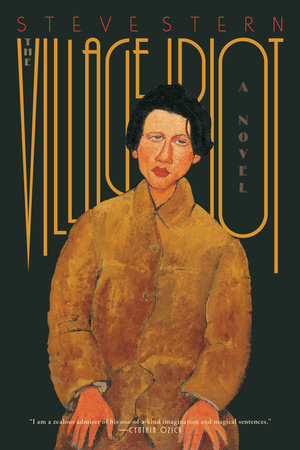
- The Village Idiot
< Back The Village Idiot Steve Stern September 13, 2022 The Village Idiot by Steve Stern (Melville House, 2022) opens with a marvelous boat race on the River Seine in 1917. The already well-known artist Amedeo Modigliani is in a bathtub ostensibly being pulled by a flock of ducks, but actually being hauled by immigrant painter Chaim Soutine. Soutine, a poorly educated, rough, and unmannered immigrant from a shtetl in the Pale of Settlement, is disoriented by the recycled air he breathes into his helmet. As he trudges along the river bottom pulling the bathtub along, he considers his past and future life. Soutine painted as a child even when it led to humiliation and beatings by his father and brothers. Neither the collectors who supported him, the friends (like Modigliani) who stood up for him, or the women who fought over him could get in the way of his painting. But then the Nazis swept across Europe, destroying everything Jewish in their path, including a generation of talented Jewish artists. Some, like Soutine, managed to evade capture. Stern’s gorgeous novel is a sweeping, imaginative story of a great artist who was uniquely brilliant but simultaneously unpleasant and unwashed. Steve Stern was born in Memphis, Tennessee in 1947, and left to attend college, then to travel before ending up on a hippie commune in the Ozarks. He studied writing in the graduate program at the University of Arkansas, at a time when it included several notable writers who've since become prominent, including poet C.D. Wright and fiction writers Ellen Gilchrist, Lewis Nordan, Lee K. Abbott and Jack Butler. In his thirties, Stern accepted a job at a local folklore center where he learned about the city's old Jewish ghetto, The Pinch, and began to steep himself in Yiddish folklore. His first book, Isaac and the Undertaker's Daughter, 1983 won the Pushcart Writers' Choice Award. By decade's end Stern had won the O. Henry Award, two Pushcart Prize awards, published more collections, including Lazar Malkin Enters Heaven (which won the Edward Lewis Wallant Award for Jewish American Fiction) and the novel Harry Kaplan's Adventures Underground, and was being hailed by critics, such as Cynthia Ozick, as the successor to Isaac Bashevis Singer. Stern's 2000 collection The Wedding Jester won the National Jewish Book Award and his novel The Angel of Forgetfulness was named one of the best books of 2005 by The Washington Pos t . Stern, who teaches at Skidmore College, has also won some notable scholarly awards, including a Fulbright fellowship and the Guggenheim foundations Fellowship. He splits his time between Brooklyn and Balston Spa, New York and enjoys hiking, climbing, biking, and kayaking. Listen to Episode Buy Book Previous Next
- Shadows We Carry
< Back Shadows We Carry Meryl Ain July 4, 2023 Meryl Ain's Shadows We Carry (Sparkspress, 2023) is a follow-up to the author’s 2020 novel, The Takeaway Men , focuses on fraternal twins Bronka and JoJo Lubinski, now in college and figuring out what to do with their lives. Beginning with the assassination of President Kennedy, we watch the sisters navigate social upheaval, family expectations, and all the usual aspects of growing up, but they were born in a DP camp after WW2 and are children of Holocaust Survivors, now referred to as “Second - Generation Survivors.” They’ve inherited their parents’ guilt (their mother lives a Jewish life but never converted) and emotional trauma (their father’s first family was killed by Nazis) but they live in 1960s and 70s New York and also have to navigate relationships, career dreams, and social expectations for women of that generation. Then Branka, who dreams of becoming a serious journalist but has been relegated to the food column, is asked to cover a neo-Nazi protest, and her eyes are opened to the presence of Hitler acolytes in this country. Meryl Ain is a writer, author, podcaster, and career educator. She received a BA in Political Science from Queens College, holds an MA in Teacher History from Columbia University, and earned a doctorate in Educational Administration from Hofstra University. She has worked as a journalist and her articles and essays were published in many publications, but most of her career was spent working as a high school history teacher and administrator. Her award-winning post-Holocaust debut novel, The Takeaway Men , was published in 2020. She is the host of the podcast, People of the Book , and the founder of the Facebook group, Jews Love To Read! which has more than 4,000 members. Her novels are a result of her life-long quest to learn more about the Holocaust, a thirst that was first triggered by reading The Diary of Anne Frank in the sixth grade. When she's not reading or writing, she enjoys meeting with groups to discuss her books. She's a lifetime member of Hadassah, a member of The International Advisory Board for Holocaust Survivor Day, a supporter of UJA-Federation, as well as Holocaust centers and causes. Meryl lives in New York with her husband, Stewart. Her greatest joy is spending time with their six grandchildren. Listen to Episode Buy Book Previous Next
- The Pain of Pleasure
< Back The Pain of Pleasure Amy Grace Loyd July 25, 2023 In Amy Grace Loyd’s new novel, The Pain of Pleasure (Roundabout Press 2023), nearly everyone suffers some kind of intense pain. Some find their way to the Doctor, formerly a respected neurologist but now director of a headache clinic in the basement of what was once a Brooklyn church. He experiments with different treatments for a wide variety of migraine sufferers but can’t stop obsessing over Sarah, the patient who suddenly broke off contact with the clinic and disappeared, leaving only a journal that describes her affair with a married man. The Doctor’s salary and the clinic’s costs are underwritten by a wealthy patron, Adele Watson, who, because she believes the doctor was in love with Sarah, is also obsessed. Mrs. Watson hires Ruth, a nurse with her own troubled back story, to spy on the Doctor. And the fragile balance between patient health and trust in The Doctor starts to crumble when a hurricane sweeps through New York, upending or destroying whatever is in its path. Amy Grace Loyd is an editor, teacher, and author of the novels The Affairs of Others , a BEA Buzz Book and Indie Next selection, and The Pain of Pleasure . She began her career at independent book publisher W.W. Norton & Company and The New Yorker , in the magazine’s fiction and literary department. She was the associate editor on the New York Review Books Classics series and the fiction and literary editor at Playboy magazine and later at Esquire . She’s also worked in digital publishing, as an executive editor at e-singles publisher Byliner and as an acquiring editor and content creator for Scribd Originals. She has been an adjunct professor at the Columbia University MFA writing program and a MacDowell and Yaddo fellow. She lives between New York and New Hampshire. Amy loves to get lost in music, dance wildly to wild music, walk long distances, often with NO PHONE on hand, just the sounds of the world around her as she moves, especially the sounds of trees (she’s made for trees). She is passionate about silence and solitude and kindness in an unkind world. We all have a lot of healing to do these days and she keeps searching for ways to achieve that for herself and others. Listen to Episode Buy Book Previous Next
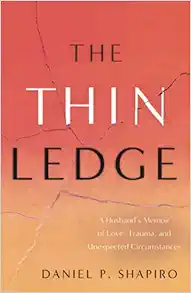
- The Thin Ledge
< Back The Thin Ledge Daniel Shapiro July 27, 2021 Daniel Shapiro was a successful attorney in his early forties when his wife, Susan, suffered a brain bleed and a diagnosis that her future was uncertain. Stunned, and with three young children, the couple made the most of the few years that followed, before a massive second hemorrhage changed everything. Physically, Susan was badly compromised in her ability to speak, see, and walk. Mentally, she spiraled into depression and experienced a drastic personality change. The Thin Ledge: A Husband’s Memoir of Love, Trauma, and Unexpected Circumstances (River Grove Books, 2021) is about coping (often unsuccessfully) with the wreckage left in the wake of an illness that destroys a loved one. Shapiro addresses the questions that people living through unspeakable tragedy may never mention, but almost always ask. Daniel P. Shapiro completed his undergraduate degree as a member of Phi Beta Kappa at the University of Illinois, and earned a J.D. at the University of Chicago Law School. He grew up in the northern Chicago suburbs, his mother a homemaker and his father a professional artist. Daniel has always loved both photography and writing. Before practicing law, he was a contributing writer for a local newspaper. Over the years, and especially while undergoing the events described in his memoir, he found writing to be an effective way to access his inner thoughts and to think in a constructive way about the challenges he needed to address. Writing classes and working with excellent teachers (to whom he is immensely grateful) helped him hone his skills, with the result being his memoir, The Thin Ledge. He is already at work on a second book, a novel. Listen to Episode Buy Book Previous Next
- The Gone Dead
< Back The Gone Dead Chanelle Benz July 27, 2020 A decrepit house in Greendale, Mississippi once belonged to Billie James’s father, a renowned black poet who died unexpectedly when she was four years old. Her mother dies of cancer. Then years later, her paternal grandmother dies and leaves Billie the old Mississippi Delta house. At age 34, Billie returns to the house, encounters the locals, and learns that on the day her father died, she went missing. She doesn’t want to leave Mississippi until she finds out what happened, but someone doesn’t want Billie to know the truth. Told from several perspectives, The Gone Dead (Ecco, 2019) is a story about family and memory, justice for those who were never given a chance, and some of the wounds caused by racism in America. Chanelle Benz has published work in Guernica, Granta.com, The New York Times, Electric Literature, The American Reader , Fence and others, and is the recipient of an O. Henry Prize. Her story collection The Man Who Shot Out My Eye Is Dead was named a Best Book of 2017 by The San Francisco Chronicle and one of Electric Literature’s 15 Best Short Story Collections of 2017. It was also shortlisted for the 2018 Saroyan Prize and longlisted for the 2018 PEN/Robert Bingham Prize for Debut Fiction and the 2017 Story Prize. The Gone Dead was a New York Times Book Review Editor’s Choice and a Tonight Show Summer Reads Finalist. It was long-listed for the 2020 PEN/Hemingway Award for Debut Novel and the 2019 Center for Fiction First Novel Prize. It was also named a best new book of the summer by O, The Oprah Magazine , Time , Southern Living , and Nylon . Benz currently lives in Memphis where she teaches at Rhodes College. Whenever possible, she loves to listen to true crime and history podcasts. Listen to Episode Buy Book Previous Next
- Set Adrift: A Mystery and A Memoir
< Back Set Adrift: A Mystery and A Memoir Sarah Conover June 27, 2023 When racing yacht “The Revonoc” went down in the Bermuda Triangle’s Sargasso Sea during a freakish storm in January of 1958, the sailing world was dumbfounded. The boat and five people on board, all well-known in the sailing world, completely vanished. Only the dinghy showed up a few days later, but all searches over the following months turned up nothing at all. Sarah Conover, the youngest of the two daughters of Lori and Larry, and granddaughters of Dorothy and Harvey, became an orphan that day. As an adult, Sarah began to ask questions about her parents and grandparents – her memoir weaves interviews with family members, articles, and official Coast Guard reports that Sarah studies to understand her ongoing feelings of loss, loneliness, and depression. Ultimately, her final thought is “There is no true story. Only mercy.” Sarah Conover holds a BA in comparative religions from the University of Colorado, and an MFA in creative writing from Eastern Washington University. She has worked as a television producer for PBS and Internews (an international media NGO), a social worker for Catholic Charities, a public school teacher, and taught creative writing through the community colleges of Spokane, Washington. She is the author of six books on world wisdom traditions and spirituality published by Skinner House Books, the educational publishing arm of the Unitarian Universalist Association. Her poetry, essays and interviews have been published in a variety of literary magazines and anthologies. She is a feature writer and columnist for Tricycle Magazine: the Buddhist Review and has taught meditation for many years at Airway Heights Corrections Center and within the Spokane community. Ms. Conover was a recipient of Washington State’s Grants for Artist’s Projects (GAP grant) and writing fellowships from the Ucross Foundation in Clearmont, Wyoming, and the Willapa Bay Artist Residence Program in Oysterville, Washington. She lives in a condo in Spokane, Washington and in her beloved yurtiverse at the base of the North Cascades in Winthrop, Washington, where she and her husband are building a small hermitage for monastic retreats. Listen to Episode Buy Book Previous Next