G.P. Gottlieb: Murder, Mystery, and Recipes: Just a Little Cozy


Search Results
Search Results
Search this site
726 results found with an empty search
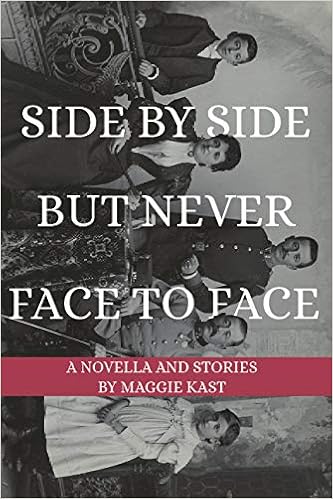
- Side by Side but Never Face to Face
Starting in Jamaica, the stories shift back and forth in time and place, from Europe to Chicago to Door County, Wisconsin. We follow Greta’s emotional journey, spiritual longings, and religious awakening as she survives the complexities of a full life. < Back Side by Side but Never Face to Face Maggie Kast July 1, 2020 During the first few stories, we think the book centers on Manfred, an Austrian Holocaust survivor whose parents converted out of Judaism to save him from centuries of oppression. He and his third wife, Greta, are forced to mourn the accidental death of their youngest child, a trauma that affects them deeply but differently. Only after several stories focused on Manfred’s upbringing and young adulthood do we realize that the protagonist is his wife and then widow, Greta. Starting in Jamaica, the stories shift back and forth in time and place, from Europe to Chicago to Door County, Wisconsin. We follow Greta’s emotional journey, spiritual longings, and religious awakening as she survives the complexities of a full life. Today I talked to Maggie Kast about her new book Side by Side but Never Face to Face: A Novella and Stories (Orison Books, 2020) Kast received an M.F.A. in writing from Vermont College of Fine Arts and has published fiction in The Sun, Nimrod, Rosebud, Paper Street and others. A chapter of her memoir, published in ACM/Another Chicago Magazine , won a Literary Award from the Illinois Arts Council. Her essays have appeared in America, Image, Writer’s Chronicle, and Superstition Review and have been anthologized in Love You to Pieces: Creative Writers on Raising a Child with Special Needs (Beacon Press) and Gravity Pulls You In: Perspectives on Parenting Children on the Autism Spectrum (Woodbine House). Kast is a Board Member of Links Hall , an incubator and presenter of dance and performance art in Chicago. When not writing, Maggie loves cooking, and although she loves traditional midwestern food, also specialized in Viennese cuisine. Listen to Episode Buy Book Previous Next
- Nermina's Chance
Nermina is a medical student in Sarajevo. She’s been raised in an educated family of Westernized, secular Muslims, but it’s 1992 and the Serbian Chetniks have started to destroy the city. < Back Nermina's Chance Dina Greenberg November 30, 2021 Today I talked to Dina Greenberg about her new novel Nermina's Chance (Atmosphere Press, 2021). Nermina is a medical student in Sarajevo. She’s been raised in an educated family of Westernized, secular Muslims, but it’s 1992 and the Serbian Chetniks have started to destroy the city. Her mother and brother are murdered and Nermina is brutally raped. She manages to bribe her way out of Bosnia, flees with an orphaned five-year-old whom she leaves with relatives, and ultimately ends up in Portland, Oregon. She starts to rebuild her life and resolves to bring her own child into the world, but she’s twenty-four and can’t afford a medically induced pregnancy. So, she entices a ‘sperm donor’ who has no idea of her intentions. Through pregnancy and the first sixteen years of her daughter’s life, Nermina completes her degrees and begins counseling traumatized combat veterans. One of them turns out to be the brother of Nermina’s unknowing sperm donor. Nominated for The Pushcart Prize, Best Small Fictions, and The Millions, Dina Greenberg’s poetry, fiction, and creative nonfiction have appeared widely in such journals as Bellevue Literary Review, Pembroke Magazine, Split Rock Review, Tahoma Literary Review, Barely South, and Wilderness House Literary Review. Dina earned an MFA in fiction from the University of North Carolina Wilmington, where she served as managing editor for the literary journal Chautauqua. She teaches creative writing at the Cameron Art Museum and provides one-on-one writing coaching for victims of trauma. Her work leading creative writing workshops for combat veterans resulted in Nermina’s Chance . When she’s not writing, teaching, or reading, Dina loves to work transforming a previously litter-strewn median into what she and a group of neighbors hope will be a city oasis. She also loves iPhone photography, building things (think DIY compost tumbler, raised garden beds, etc.), and power walking on Wilmington, NC’s Riverwalk. Listen to Episode Buy Book Previous Next
- The Waters
Hermine “Herself” Zook is a healer who rules over an island in a swampy area of Michigan known as “The Waters.” People, including her three grown daughters, fear her, but her powerful herbal and plant-based medicines have cured the townspeople for decades of viruses, pains, and unwanted pregnancies. < Back The Waters Bonnie Jo Campbell October 29, 2024 Hermine “Herself” Zook is a healer who rules over an island in a swampy area of Michigan known as “The Waters.” People, including her three grown daughters, fear her, but her powerful herbal and plant-based medicines have cured the townspeople for decades of viruses, pains, and unwanted pregnancies. Her first two daughters Molly and Prim were foundlings, but Rose Thorn is the product of Hermine’s husband having an affair with Prim before getting kicked off the island. Herself, now nearly eighty, is raising eleven-year-old granddaughter Dorothy “Donkey” Zook. Donkey loves animals and longs for her mother, Rose Thorn, to marry Titus, whom she wants as her father. Donkey is the product of Rose Thorn being raped by Titus’s drunk father in this richly nuanced tale of rural poverty, changing landscapes, corporate control of farmland, religious extremism, childhood naivete, and the shaky balance between nature and humanity. Bonnie Jo Campbell ’s novel The Waters (Norton, 2024) was a Today Show “Read with Jenna” Book Club selection. Her other novels include Once Upon A River , a National Bestseller that was adapted into an award winning film, and Q Road . Campbell’s short story collections include American Salvage , which was a finalist for the National Book Award and National Book Critics Circle Award, and Women and Other Animals , an AWP Grace Paley Prize winner. She is a 2011 Guggenheim Fellow, and a recipient of the Eudora Welty Prize and Mark Twain Award. She lives in Kalamazoo with her husband and donkeys. Listen to Episode Buy Book Previous Next
- The Lost Shtetl
Imagine a Jewish village hidden in the forests of Poland that somehow escapes the Holocaust. Eighty years later, a young woman divorces her husband and runs into the surrounding forest. The town sends a young man to find her. He’s an orphan and expendable because he’s not that good a marriage prospect, but suddenly he finds himself in modern-day Poland. < Back The Lost Shtetl Max Gross February 16, 2021 Today I spoke with Max Gross about his book The Lost Shtetl (HarperCollins, 2020). Imagine a Jewish village hidden in the forests of Poland that somehow escapes the Holocaust. Eighty years later, a young woman divorces her husband and runs into the surrounding forest. The town sends a young man to find her. He’s an orphan and expendable because he’s not that good a marriage prospect, but suddenly he finds himself in modern-day Poland. He finds it hard to believe that all the Jews of Poland have been murdered along with most of Europe’s Jewry. Officials toss him in an institution and study him for months until a Yiddish translator is found. And when they fly him home in a helicopter, the townspeople think the Messiah has finally come. The Lost Shtetl is about love, family, community, religion, class, government, politics, antisemitism, assimilation, and history itself. Although the town never heard of electricity, running water, or cars, never advanced in science or medicine, and never even heard of sliced bread, it’s not clear that progress is going to be good for everyone in Kreskol. Max Gross was born in New York City in 1978 and is the son of two writers. After attending Saint Ann’s School and Dartmouth College, he worked at the Forward and as a travel correspondent for the New York Post before becoming the Editor-in-Chief of Commercial Observer. He wrote a book about dating called "From Schlub to Stud" but has since been rescued from the single man's fate by his beloved wife and son, with whom he lives in Queens, New York. The Lost Shtetl, his first novel, is a winner of the National Jewish Book Award, a recipient of an honorable mention for the Sophie Brody Medal, and winner of the Association of Jewish Libraries Fiction Award. Gross is also a lifelong traveler, having studied in Scotland and London, and having lived in Arad, Israel for a year. When not writing, he is a degenerate poker player who once had the distinction of beating the 2003 World Series of Poker champion, Chris Moneymaker , in a media versus professional tournament. Listen to Episode Buy Book Previous Next
- Becoming Sarah
Sarah Vogel was born in Auschwitz and liberated at age three, but she has no memories of being there and nobody to tell her the story of her birth or her mother. < Back Becoming Sarah Diane Botnick Sarah Vogel was born in Auschwitz and liberated at age three, but she has no memories of being there and nobody to tell her the story of her birth or her mother. Becoming Sarah (Diane Botnick, She Writes Press 2025) grapples with identity, memory, belonging, and reinventing oneself. Sarah’s trajectory is filled with both happiness and extreme loss, and she finds love, friendship, and home, but the lies she invented as a survivor follow her through her daughters and granddaughters, each of them survivors of something. Diane was born and raised in Akron, Ohio, but always knew she'd wind up in New York City. Her first night in Greenwich Village she went to a double feature of Godard’s “Weekend” and Wiseman’s “Titicut Follies,” and her romance with the city began. For the next 30 years, Diane worked around, starting out in Italy assisting people like Jerome Robbins and Ellen Stewart with their contributions to the Spoleto Festival, then back in the City for the Dia Art Foundation, Isamu Noguchi, Great Performances at WNET, and finally, Workman Publishing. Along the way, she returned to school in pursuit of a master’s in creative writing at City College. Fulfilling all requirements but unable to pass the French exam (with a dictionary!), she was never awarded her diploma. However, the privilege of being mentored by Donald Barthelme and being appointed student editor of the literary magazine FICTION gave her far more than a diploma ever could. Listen to Episode Buy Book Previous Next
- Dreaming the Marsh
A giant sinkhole begins swallowing an enormous swath of a marsh-like ecosystem that has been slated for development, along with parts of a highway and a large lake. The citizens of Opakulla, Florida struggle to understand what is happening as the land is sucked under. They’re also perplexed by un-erasable writing that appears on their new town hall. The sinkhole starts wreaking havoc with their lives and nobody knows what to do about it. < Back Dreaming the Marsh Elizabeth McCulloch December 29, 2020 Elizabeth McCulloch was born in Buenos Aires, Argentina, and lived in New England, the Midwest, Canada, and the South, before putting down roots in Gainesville, Florida, almost forty years ago. Previously a lawyer, then a teacher, she has had children of various stripes: one born, two foster, one step, and the granddaughter she is now raising with her husband. Elizabeth has always loved to read and always wanted to write. She began seriously pursuing her dream over 30 years ago, with pauses in the pursuit for various events and catastrophes. She has completed three novels and is working on a fourth. At her blog, The Feminist Grandma, she writes illustrated personal essays about family, friends, aging, social justice issues, and whatever takes her fancy. At Big Books from Small Presses, she posts illustrated reviews and other essays about books. Both blogs are at her website, elizabethmccullochauthor.com. When Elizabeth isn’t reading or writing, she sings at a nursing home, swims, gardens, dances, cooks, and has mastered baking pie crusts. In Dreaming the Marsh (Twisted Road, 2019), a giant sinkhole begins swallowing an enormous swath of a marsh-like ecosystem that has been slated for development, along with parts of a highway and a large lake. The citizens of Opakulla, Florida struggle to understand what is happening as the land is sucked under. They’re also perplexed by un-erasable writing that appears on their new town hall. The sinkhole starts wreaking havoc with their lives and nobody knows what to do about it. A lovesick geologist wants to study it, the real estate developers relish its wild beauty, the mayor and members of the town commission want something done to stop it, and the owner of a local café, who speaks with the Ancients, understands it. But she isn’t telling. Listen to Episode Buy Book Previous Next
- Cravings
Garnett Kilberg Cohen’s 4th story collection is about people of all kinds who confront past failures, previous mistakes, or moments they wish they could do over. A man recalls a fall that changed his family’s life, a woman thinks about an abortion that went bad, an aging hippie confronts the death of his best friend – these are detailed, well-told, poignant stories that will stay with you. < Back Cravings Garnett Kilberg Cohen February 13, 2024 Garnett Kilberg Cohen’s fourth short story collection, Cravings ( University of Wisconsin Press, 2024), contains twelve beautifully-written tales. They each start simply before delving into universal human struggles of love, aging, repercussions, and community. Characters mull over or confront decisions and recognize or bemoan past mistakes. A little girl’s life changes while she’s sneaking olives from the pantry, a woman is plunged back in time while attending the book release of her ex, parents of a disabled child struggle as their marriage frays, the daughter of an ex appears on television, and a woman destroys the reputation of her only friend. The collection is about cravings of one kind or another, but also covers a range of complex emotions that arise over the course of a lifetime. Garnett Kilberg Cohen was born and raised in Ohio and feels a strong connection to the Midwest, a place in her memory that is replete with farms, small towns, car factories and fields of corn and purple clover. As a child, she was paid one cent for every five dandelions she ripped by the roots from her family’s yard. Her favorite drink was a cherry phosphate sipped while twirling on a stool at the marble counter of the village drug store. Yet, she was aware of the secrets and trauma often just below the surface. Cravings is Cohen’s fourth collection of short stories. She has also published a poetry chapbook, Passion Tour and multiple essays in such places as Rumpus, Antioch Review, The New Yorker online and Michigan Quarterly Review . Her honors include The Crazyhorse Fiction Prize, four awards from the Illinois Arts Council, and two Notable Essay citations from Best American Essays . In addition to writing and reading, she enjoys drawing, taking long walks, theater, museums and travel. In recent years, she has been fortunate to travel to far-flung places such as Taiwan, Australia, Laos, Tanzania, Iceland and Mexico. She believes that observation is often the key to understanding and inspiration for writing—even if the travel is just to a new neighborhood in the city where she now lives, Chicago. Listen to Episode Buy Book Previous Next
- Devil by the Tail
It’s 1867, and a 20-something civil war widow has just set up a detective agency with a former rebel soldier named Gabriel Garnick. She uses a professional name, Mrs. Paschal, so nobody connects her with the former in-laws who are trying to stop her from receiving her dead husband’s estate. < Back Devil by the Tail Jeanne Matthews August 10, 2021 Today I talked to Jeanne Matthews about her new novel Devil by the Tail (D.X. Varos, 2021) It’s 1867, and a 20-something civil war widow has just set up a detective agency with a former rebel soldier named Gabriel Garnick. She uses a professional name, Mrs. Paschal, so nobody connects her with the former in-laws who are trying to stop her from receiving her dead husband’s estate. Garnick and Paschal get two cases on the same day – the first to help prove a man innocent of murdering his wife, the second to find reasonable doubt for an accused murderer. Imagine their surprise when the cases turn out to be linked? And imagine 19th Century pre-fire Chicago, teeming with corrupt politicians, gambling parlors, and bawdy houses of ill-repute. Also, someone is trying to murder Quinn Sinclair, aka Mrs. Paschal. Jeanne Matthews graduated from the University of Georgia with a degree in Journalism and has worked as a copywriter, a high school English and Drama teacher, and a paralegal. She worked for litigators for twenty years, and there was seldom a day when she didn’t fantasize about murder. So, it was no wonder when she turned to writing murder mysteries. Matthews’ five-book Dinah Pelerin mystery series published by Poisoned Pen Press between 2010 and 2015 received glowing reviews from Library Journal, Booklist, and Publisher’s Weekly. The settings for these books (Bones of Contention, Bet Your Bones, Bonereapers, Her Boyfriend’s Bones and Where the Bones Are Buried) range from the Australian Outback to the Norwegian Arctic to the sophisticated noir of Berlin. Matthews and her husband, a law professor, currently live in Washington State with Jack Reacher, their Norwich terrier. She loves travel, hiking, and photography, plays old torch songs from the 1930’s and 40’s on piano after a few glasses of wine, and enjoys cooking and baking. She also plays a mean game of Scrabble. Listen to Episode Buy Book Previous Next
- What Passes as Love
In 1850, at age six, Dahlia Holt is taken from the only home she knows and moved into the big house to serve her two older sisters. They share a father, who owns the house and its slaves. On her sixteenth birthday, Dahlia gets to dress up in one of the sister’s discarded dresses for a trip to the city. There, she gets separated from her family, and meets a young Englishman who thinks she’s white. < Back What Passes as Love Trisha R. Thomas August 31, 2021 Today I talked to Trisha R. Thomas about her new novel What Passes as Love (Lake Union Publishing, 2021). In 1850, at age six, Dahlia Holt is taken from the only home she knows and moved into the big house to serve her two older sisters. They share a father, who owns the house and its slaves. On her sixteenth birthday, Dahlia gets to dress up in one of the sister’s discarded dresses for a trip to the city. There, she gets separated from her family, and meets a young Englishman who thinks she’s white. She introduces herself as an orphan without a family. It starts out as a lark, but her adventures could destroy those she left behind. Especially after her father puts a high bounty on her head, because she is, after all, a runaway slave. TRISHA R. THOMAS won the Literary Lion Award from the King County Library Foundation. Her first book, Nappily Ever After, was a finalist for an NAACP Image Award for Outstanding Literature as well as being featured in O Magazine’s Books That Make a Difference. Her work has been reviewed in the Washington Post, Publishers Weekly, Kirkus Reviews, Booklist, and the Seattle Post Intelligencer. Her debut novel is now adapted to a feature film on Netflix. She’s had 11 novels published and continues to write from her home in California. When she’s not writing, she’s tending to her mini farm where she grows tomatoes, avocados, and lemons, all the perfect ingredients for guacamole and avocado toast. Listen to Episode Buy Book Previous Next
- C.S. Harris
C.S. Harris: Sebastian St. Syr Mystery Series < Back C.S. Harris Author of The Sebastian St. Syr Mystery Series September 29, 2021 C.S. Harris, aka Candice Proctor and C.S. Graham , is the bestselling, award-winning author of more than a dozen novels including the Sebastian St. Cyr Regency 17 book mystery series about an aristocratic detective in early 1800’s England (I LOVED What the Devil Knows, Who Slays the Wicked, Where Shadows Dance etc…). She also co-wrote a C.S. Graham thriller series and seven historical romances plus a nonfiction historical study of the French Revolution. Her books are available worldwide and have been translated into over twenty different languages. Candice graduated Phi Beta Kappa, summa cum laude with a degree in Classics before going on to earn an MA and Ph.D. in history. A former academic, she has taught at the University of Idaho and Midwestern State University in Texas. The daughter of a career Air Force officer and a university professor, she spent many years as a partner in an international business consulting firm. She also worked as an archaeologist on a variety of sites including a Hudson’s Bay Company Fort in San Juan Island, a Cherokee village in Tennessee, a prehistoric kill site in Victoria, Australia, and a Roman cemetery and medieval manor house in Winchester, England. Previous Next
- A Child Lost
Fifth in the Henrietta and Inspector Howard Mystery Series, A Child Lost (She Writes Press, 2020) begins in 1935, with Henrietta’s younger sister, Elsie, falling in love with Gunther, a German refugee. < Back A Child Lost Michelle Cox August 3, 2021 Fifth in the Henrietta and Inspector Howard Mystery Series, A Child Lost (She Writes Press, 2020) begins in 1935, with Henrietta’s younger sister, Elsie, falling in love with Gunther, a German refugee. He has come to America to locate Liesel, the mother of a little girl he’s been caring for, and has been working in maintenance at Elsie’s school. Elsie begs Henrietta and Clive to help find Liesel, which leads to the old Dunning Asylum on Chicago’s north side. The little girl, who has been having epileptic fits, is also spirited away to the horrible place. Henrietta and Clive brave filth and chaos to get her out, but Henrietta later realizes that everything wasn’t as it seemed. Meanwhile, Clive is assigned to investigate a spiritualist living on the north shore, who might be robbing people of their valuables. It seems like a boring case until Henrietta starts falling for the spiritualist’s visions. Michelle Cox holds a B.A. in English literature from Mundelein College, Chicago and is the author of the multiple award-winning Henrietta and Inspector Howard series as well as “Novel Notes of Local Lore,” a weekly blog dedicated to Chicago’s forgotten residents. She suspects she may have once lived in the 1930s and, having yet to discover a handy time machine lying around, has resorted to writing about the era as a way of getting herself back there. Coincidentally, her books have been praised by Kirkus, Library Journal, Publishers Weekly, Booklist and many others, so she might be on to something. Unbeknownst to most, Michelle hoards board games she doesn’t have time to play and is, not surprisingly, addicted to period dramas and big band music. Also, marmalade. Listen to Episode Buy Book Previous Next
- The Wild Birds
An orphaned young woman disguises herself as a boy in order to escape the dangers of being alone in 1870’s San Francisco. A group of castoffs destroy the bird population of the Farallon Island by stealing and selling their eggs. < Back The Wild Birds Emily Strelow February 26, 2020 An orphaned young woman disguises herself as a boy in order to escape the dangers of being alone in 1870’s San Francisco. A group of castoffs destroy the bird population of the Farallon Island by stealing and selling their eggs. A young woman raped in the 1980’s struggles to raise her daughter on her own while her unattached best friend becomes a field researcher for the government, counting and monitoring bird populations across the west. The daughter runs away to seek her own path and learns something about her mother, and a wanderer escapes his privileged life to seek his destiny. Everything in this novel is connected to wild birds, the geography of the west, and friendship. And the characters are all tied together by a rare collection of bird eggs. Emily Strelow was born and raised in Oregon’s Willamette Valley, has lived all over the West, and is back living in Portland. For the last decade she’s combined teaching writing with doing seasonal avian field biology with her husband. While doing field jobs, she’s camped and written in remote areas of the desert, mountains and by the ocean. She is a mother to two boys, a naturalist, a writer, and cultivator of sourdough cultures with which she loves baking. The Wild Birds (Rare Bird Books, 2018), her first novel, was a finalist for the Foreword Indies Award for Best Fiction and for the Lambda Literary Award for Bisexual Fiction. It is now available in all formats, and a second book is in the works. Listen to Episode Buy Book Previous Next