G.P. Gottlieb: Murder, Mystery, and Recipes: Just a Little Cozy


Search Results
Search Results
Search this site
726 results found with an empty search
- This Room is Made of Noise
Don Lank is a newly divorced handyman who spots an imitation Tiffany lamp in the front window of a house and offers the elderly owner $800 for it. He’s shocked to get a check for fifteen thousand and returns to the house to give 95-year-old Millie most of the money. < Back This Room is Made of Noise Stephen Schottenfeld August 20, 2024 Don Lank is a newly divorced handyman who spots an imitation Tiffany lamp in the front window of a house and offers the elderly owner $800 for it. He’s shocked by the price he gets and returns to give 95-year-old Millie most of the money. While he’s there, he offers to do a couple of repairs in her deteriorating house, and over the course of the next few weeks and months, spends more and more time with her fixing her house, taking her to doctors’ appointments, buying her grocers, and slowly beginning to oversee her care. He’s also trying to repair his relationships with his father, his ex-wife, and his stepchildren. He’s not sure why he’s helping Millie, but struggles to focus on being altruistic and not merely greedy. Stephen Schottenfeld is the author of two Bluff City Pawn (Bloomsbury USA, 2014). His short stories have appeared in The Gettysburg Review , TriQuarterly , StoryQuarterly , The Virginia Quarterly Review , New England Review , The Iowa Review , and other journals, and have received special mention in both the Pushcart Prize and Best American Short Stories anthologies. He holds an MFA from the Iowa Writers’ Workshop, and was awarded a Michener/Copernicus Society of America grant, a Halls Fiction Fellowship from the University of Wisconsin-Madison, and a Shane Stevens Fellowship in the Novel from the Bread Loaf Writers’ Conference. His narratives often trace the work lives of his characters—pawnbrokers, postal carriers, telephone repair people, home inspectors, police detectives, clothing manufacturers, trailer-park owners, to name a few—and explore how these professions bring an individual into a unique set of experiences and conflicts and expressions. He is a professor of English at the University of Rochester, where he teaches courses in fiction writing, screenwriting, and literature. When he is not writing or reading or teaching, he likes to walk the parks of Rochester, NY. Listen to Episode Buy Book Previous Next
- The Counterfeit Wife
Philadelphia, June 1780. George Washington's two least likely spies return, masquerading as husband and wife as they search for traitors in Philadelphia. Months have passed since young widow Becca Parcell and former printer Daniel Alloway foiled a plot that threatened the new nation. < Back The Counterfeit Wife Mally Becker October 25, 2022 Today I talked to Mally Becker about her new book The Counterfeit Wife: A Revolutionary War Mystery (Level Best Books, 2022). Philadelphia, June 1780. George Washington's two least likely spies return, masquerading as husband and wife as they search for traitors in Philadelphia. Months have passed since young widow Becca Parcell and former printer Daniel Alloway foiled a plot that threatened the new nation. But independence is still a distant dream, and General Washington can't afford more unrest, not with food prices rising daily and the value of money falling just as fast. At the General's request, Becca and Daniel travel to Philadelphia to track down traitors who are flooding the city with counterfeit money. Searching for clues, Becca befriends the wealthiest women in town, the members of the Ladies Association of Philadelphia, while Daniel seeks information from the city's printers. But their straightforward mission quickly grows personal and deadly as a half-remembered woman from Becca's childhood is arrested for murdering one of the suspected counterfeiters. With time running out-and their faux marriage breaking apart-Becca and Daniel find themselves searching for a hate-driven villain who's ready to kill again. Mally Becker combines her love of history and crime fiction in mysteries that feature strong, independent heroines. She is the Agatha Award-nominated author of The Turncoat's Widow, which Kirkus Reviews called, A compelling tale ... with charming main characters. Her first novel was also named a CIBA Mystery & Mayhem finalist. A member of the board of MWA-NY, Mally was an attorney until becoming a full-time writer and an instructor at The Writers Circle Workshops. She is also a member of Sisters in Crime and the Historical Novel Society. Mally and her husband live in New Jersey, where they raised their wonderful son and spend as much time as they can hiking and kayaking. Listen to Episode Buy Book Previous Next
- The Stark Beauty of Last Things
The Stark Beauty of Last Things (She Writes Press, 2023) is set in Montauk, the far reaches of the famed Hamptons, an area under looming threat from a warming climate and overdevelopment. Now outsider Clancy, a thirty-six-year-old claims adjuster scarred by his orphan childhood, has inherited an unexpected legacy: the power to decide the fate of Montauk’s last parcel of undeveloped land. < Back The Stark Beauty of Last Things Céline Keating March 19, 2024 The Stark Beauty of Last Things (She Writes Press, 2023) is set in Montauk, the far reaches of the famed Hamptons, an area under looming threat from a warming climate and overdevelopment. Now outsider Clancy, a thirty-six-year-old claims adjuster scarred by his orphan childhood, has inherited an unexpected legacy: the power to decide the fate of Montauk’s last parcel of undeveloped land. Everyone in town has a stake in the outcome, among them Julienne, an environmentalist and painter fighting to save the landscape that inspires her art; Theresa, a bartender whose trailer park home is jeopardized by coastal erosion; and Molly and Billy, who are struggling to hold onto their property against pressure to sell. When a forest fire breaks out, Clancy comes under suspicion for arson, complicating his efforts to navigate competing agendas for the best uses of the land and to find the healing and home he has always longed for. Told from multiple points of view, The Stark Beauty of Last Things explores our connection to nature—and what we stand to lose when that connection is severed. Céline Keating is an award-winning writer and author of two novels: Layla (2011), a Huffington Post featured title, and Play for Me (2015), a finalist in the International Book Awards, the Indie Excellence Awards, and the USA Book Awards. Her short fiction and articles have been published in many literary journals and magazines. For many years a resident of Montauk, NY, Céline continues to serve on the board of environmental organization Concerned Citizens of Montauk. She is the coeditor of the anthology On Montauk: A Literary Celebration . She lives in Bristol, Rhode Island, and New York City. Listen to Episode Buy Book Previous Next
- The Last Whaler
After losing their young son in a tragic accident, Astrid, a Norwegian botanist specializing in Arctic flora, decides to join her husband, Tor, at a remote whaling station in the Arctic, where he spends every whaling season hunting belugas. In heartfelt journal entries, Astrid describes being stranded in a whaling hut through the dark season of 1937-38. < Back The Last Whaler Cynthia Reeves October 15, 2024 After losing their young son in a tragic accident, Astrid, a Norwegian botanist specializing in Arctic flora, decides to join her husband, Tor, at a remote whaling station in the Arctic, where he spends every whaling season hunting belugas. In heartfelt journal entries, Astrid describes being stranded in a whaling hut through the dark season of 1937-38. She writes about the miscalculations, the terrible weather, the fear of polar bears and freezing to death, the people they’ve met on their journey, Tor’s crew, and her slow disintegration after giving birth to another son, alone in the freezing, dark hut while Tor hunts for food. We know that Tor survived the ordeal, because he is reading Astrid’s journal filled with letters to their dead son. The Last Whaler (Regal House, 2024) is a gorgeous, well-researched historical novel about endurance, isolation, the environment, the Nazi incursion into Norway, the pain of postpartum depression, and the human will to survive. Cynthia Reeves is the author of two previous books of fiction: the novel in stories Falling Through the New World (2024), winner of Gold Wake Press’s Fiction Award; and the novella Badlands (2007), winner of Miami University Press’s Novella Prize. Her fiction, essays, and poetry have appeared widely. Most recently, her short story “The Last Glacier” was included in If the Storm Clears (Blue Cactus Press, 2024), an anthology of speculative literature that concerns the sublime in the natural world. Her lifelong interest in the Arctic began in childhood reading tales of doomed Arctic explorers. But it was her participation in the 2017 Arctic Circle Summer Solstice Expedition, which sailed Svalbard’s western shores, as well as two subsequent residencies in Longyearbyen, that have inspired her writing since then. In August 2024, she circumnavigated Svalbard aboard the icebreaker MV Ortelius carrying a hundred artists, scientists, and crew. A Hawthornden Fellow, Cynthia has also been awarded residencies to Vermont Studio Center and Art & Science in the Field. She taught creative writing at Bryn Mawr and Rosemont Colleges, and earned an MFA in Creative Writing from Warren Wilson’s low-residency program. She lives with her husband in Camden, Maine. Find out more at cynthiareeveswriter.com . Listen to Episode Buy Book Previous Next
- The Lamps of Albarracin
The Lamps of Albarracin tells the story of Sarita, who looks back on her life before and after the Inquisition arrived in her town. It’s 15th century Spain, and Sarita is the daughter and assistant of the town’s Jewish doctor. < Back The Lamps of Albarracin Edith Saavedra April 19, 2022 The Lamps of Albarracin tells the story of Sarita, who looks back on her life before and after the Inquisition arrived in her town. It’s 15th century Spain, and Sarita is the daughter and assistant of the town’s Jewish doctor. She recalls living in a warm, loving household with her sisters and brother and Torah lessons taught by Solomon the Aged. She was raised with several languages and always looking forward to the next holiday. In the kingdom of Aragon, Albarracin was a town in which Christians, Muslims, and Jews still lived mostly in harmony, although the winds of change have started blowing across the Iberian Peninsula. We watch Sarita grow up – she’s skilled with healing, which helps her survive the punishment she receives from the Spanish Inquisition. She hadn’t known that she’d been baptized at birth. Rooted in Judaism, Sarita finds ways to live as her true self even when confined to a convent or masquerading as Muslim to escape the Inquisition. Edith Scott Saavedra was born in California to an American father and a mother from the Republic of Panama. She earned her B.A. (magna cum laude) and J.D. from Harvard University and has had a distinguished career as an international lawyer, business consultant, and author, based in Hong Kong and Singapore. She is the co-author of several leading nonfiction works on the competitiveness of industries, regions and nations. She’s currently focused on educating the public in the United States and Spain, particularly students, about Sephardic heritage and history, including true stories of resistance to the Inquisition, the contributions of the Sephardim to Spain, and the importance of interfaith friendship. Listen to Episode Buy Book Previous Next
- The Man Who Loved His Wife
Peppered with Yiddishisms and salted with sisters, brothers, parents, children, grandparents, neighbors, and friends, Moses tells the stories of regular people faced with the problems of daily life but weighted with the 4000-year-old history of Judaism. < Back The Man Who Loved His Wife Jennifer Anne Moses March 9, 2021 In The Man Who Loved His Wife (Mayapple Press, 2021), Jennifer Anne Moses creates characters who grapple with the minutiae of their lives while considering family, fate, love, death, the afterlife, the divine presence, and spirituality. Peppered with Yiddishisms and salted with sisters, brothers, parents, children, grandparents, neighbors, and friends, Moses tells the stories of regular people faced with the problems of daily life but weighted with the 4000-year-old history of Judaism. She is reminiscent of writers like Isaac Bashevis Singer, Cynthia Ozick, Chaim Grade, and Philip Roth (to name a few) who captured the spirit of humanity in a specific time and place. Jennifer Anne Moses was born in 1959 and grew up in McLean, Virginia. She always wanted to be a writer, so she read a lot and later earned a degree at Tufts. Eventually she married, had three children, taught herself to paint, and moved from Washington D.C. to Baton Rouge, Louisiana to Montclair, NJ. In addition to her books (Food and Whine , The Book of Joshua , Bagels and Grits , Visiting Hours , Tales from My Closet , and The Art of Dumpster Diving ), she's published dozens of essays, articles, Op Ed pieces, and short stories. Her work has also been anthologized in the Pushcart Prizes and New Stories from the South: The Year's Best. Moses loves to bicycle, garden, play the piano, and dance, although she can’t do it like she used to. She also adores her two smelly mutts. Listen to Episode Buy Book Previous Next
- Side by Side but Never Face to Face
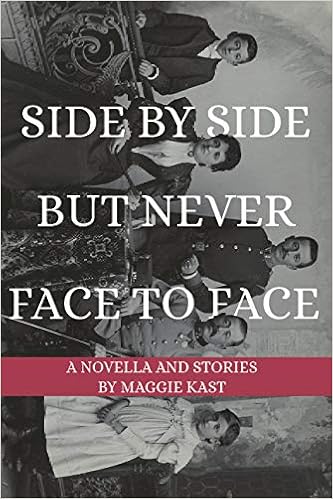
Starting in Jamaica, the stories shift back and forth in time and place, from Europe to Chicago to Door County, Wisconsin. We follow Greta’s emotional journey, spiritual longings, and religious awakening as she survives the complexities of a full life. < Back Side by Side but Never Face to Face Maggie Kast July 1, 2020 During the first few stories, we think the book centers on Manfred, an Austrian Holocaust survivor whose parents converted out of Judaism to save him from centuries of oppression. He and his third wife, Greta, are forced to mourn the accidental death of their youngest child, a trauma that affects them deeply but differently. Only after several stories focused on Manfred’s upbringing and young adulthood do we realize that the protagonist is his wife and then widow, Greta. Starting in Jamaica, the stories shift back and forth in time and place, from Europe to Chicago to Door County, Wisconsin. We follow Greta’s emotional journey, spiritual longings, and religious awakening as she survives the complexities of a full life. Today I talked to Maggie Kast about her new book Side by Side but Never Face to Face: A Novella and Stories (Orison Books, 2020) Kast received an M.F.A. in writing from Vermont College of Fine Arts and has published fiction in The Sun, Nimrod, Rosebud, Paper Street and others. A chapter of her memoir, published in ACM/Another Chicago Magazine , won a Literary Award from the Illinois Arts Council. Her essays have appeared in America, Image, Writer’s Chronicle, and Superstition Review and have been anthologized in Love You to Pieces: Creative Writers on Raising a Child with Special Needs (Beacon Press) and Gravity Pulls You In: Perspectives on Parenting Children on the Autism Spectrum (Woodbine House). Kast is a Board Member of Links Hall , an incubator and presenter of dance and performance art in Chicago. When not writing, Maggie loves cooking, and although she loves traditional midwestern food, also specialized in Viennese cuisine. Listen to Episode Buy Book Previous Next
- Nermina's Chance
Nermina is a medical student in Sarajevo. She’s been raised in an educated family of Westernized, secular Muslims, but it’s 1992 and the Serbian Chetniks have started to destroy the city. < Back Nermina's Chance Dina Greenberg November 30, 2021 Today I talked to Dina Greenberg about her new novel Nermina's Chance (Atmosphere Press, 2021). Nermina is a medical student in Sarajevo. She’s been raised in an educated family of Westernized, secular Muslims, but it’s 1992 and the Serbian Chetniks have started to destroy the city. Her mother and brother are murdered and Nermina is brutally raped. She manages to bribe her way out of Bosnia, flees with an orphaned five-year-old whom she leaves with relatives, and ultimately ends up in Portland, Oregon. She starts to rebuild her life and resolves to bring her own child into the world, but she’s twenty-four and can’t afford a medically induced pregnancy. So, she entices a ‘sperm donor’ who has no idea of her intentions. Through pregnancy and the first sixteen years of her daughter’s life, Nermina completes her degrees and begins counseling traumatized combat veterans. One of them turns out to be the brother of Nermina’s unknowing sperm donor. Nominated for The Pushcart Prize, Best Small Fictions, and The Millions, Dina Greenberg’s poetry, fiction, and creative nonfiction have appeared widely in such journals as Bellevue Literary Review, Pembroke Magazine, Split Rock Review, Tahoma Literary Review, Barely South, and Wilderness House Literary Review. Dina earned an MFA in fiction from the University of North Carolina Wilmington, where she served as managing editor for the literary journal Chautauqua. She teaches creative writing at the Cameron Art Museum and provides one-on-one writing coaching for victims of trauma. Her work leading creative writing workshops for combat veterans resulted in Nermina’s Chance . When she’s not writing, teaching, or reading, Dina loves to work transforming a previously litter-strewn median into what she and a group of neighbors hope will be a city oasis. She also loves iPhone photography, building things (think DIY compost tumbler, raised garden beds, etc.), and power walking on Wilmington, NC’s Riverwalk. Listen to Episode Buy Book Previous Next
- The Waters
Hermine “Herself” Zook is a healer who rules over an island in a swampy area of Michigan known as “The Waters.” People, including her three grown daughters, fear her, but her powerful herbal and plant-based medicines have cured the townspeople for decades of viruses, pains, and unwanted pregnancies. < Back The Waters Bonnie Jo Campbell October 29, 2024 Hermine “Herself” Zook is a healer who rules over an island in a swampy area of Michigan known as “The Waters.” People, including her three grown daughters, fear her, but her powerful herbal and plant-based medicines have cured the townspeople for decades of viruses, pains, and unwanted pregnancies. Her first two daughters Molly and Prim were foundlings, but Rose Thorn is the product of Hermine’s husband having an affair with Prim before getting kicked off the island. Herself, now nearly eighty, is raising eleven-year-old granddaughter Dorothy “Donkey” Zook. Donkey loves animals and longs for her mother, Rose Thorn, to marry Titus, whom she wants as her father. Donkey is the product of Rose Thorn being raped by Titus’s drunk father in this richly nuanced tale of rural poverty, changing landscapes, corporate control of farmland, religious extremism, childhood naivete, and the shaky balance between nature and humanity. Bonnie Jo Campbell ’s novel The Waters (Norton, 2024) was a Today Show “Read with Jenna” Book Club selection. Her other novels include Once Upon A River , a National Bestseller that was adapted into an award winning film, and Q Road . Campbell’s short story collections include American Salvage , which was a finalist for the National Book Award and National Book Critics Circle Award, and Women and Other Animals , an AWP Grace Paley Prize winner. She is a 2011 Guggenheim Fellow, and a recipient of the Eudora Welty Prize and Mark Twain Award. She lives in Kalamazoo with her husband and donkeys. Listen to Episode Buy Book Previous Next
- The Lost Shtetl
Imagine a Jewish village hidden in the forests of Poland that somehow escapes the Holocaust. Eighty years later, a young woman divorces her husband and runs into the surrounding forest. The town sends a young man to find her. He’s an orphan and expendable because he’s not that good a marriage prospect, but suddenly he finds himself in modern-day Poland. < Back The Lost Shtetl Max Gross February 16, 2021 Today I spoke with Max Gross about his book The Lost Shtetl (HarperCollins, 2020). Imagine a Jewish village hidden in the forests of Poland that somehow escapes the Holocaust. Eighty years later, a young woman divorces her husband and runs into the surrounding forest. The town sends a young man to find her. He’s an orphan and expendable because he’s not that good a marriage prospect, but suddenly he finds himself in modern-day Poland. He finds it hard to believe that all the Jews of Poland have been murdered along with most of Europe’s Jewry. Officials toss him in an institution and study him for months until a Yiddish translator is found. And when they fly him home in a helicopter, the townspeople think the Messiah has finally come. The Lost Shtetl is about love, family, community, religion, class, government, politics, antisemitism, assimilation, and history itself. Although the town never heard of electricity, running water, or cars, never advanced in science or medicine, and never even heard of sliced bread, it’s not clear that progress is going to be good for everyone in Kreskol. Max Gross was born in New York City in 1978 and is the son of two writers. After attending Saint Ann’s School and Dartmouth College, he worked at the Forward and as a travel correspondent for the New York Post before becoming the Editor-in-Chief of Commercial Observer. He wrote a book about dating called "From Schlub to Stud" but has since been rescued from the single man's fate by his beloved wife and son, with whom he lives in Queens, New York. The Lost Shtetl, his first novel, is a winner of the National Jewish Book Award, a recipient of an honorable mention for the Sophie Brody Medal, and winner of the Association of Jewish Libraries Fiction Award. Gross is also a lifelong traveler, having studied in Scotland and London, and having lived in Arad, Israel for a year. When not writing, he is a degenerate poker player who once had the distinction of beating the 2003 World Series of Poker champion, Chris Moneymaker , in a media versus professional tournament. Listen to Episode Buy Book Previous Next
- Becoming Sarah
Sarah Vogel was born in Auschwitz and liberated at age three, but she has no memories of being there and nobody to tell her the story of her birth or her mother. < Back Becoming Sarah Diane Botnick Sarah Vogel was born in Auschwitz and liberated at age three, but she has no memories of being there and nobody to tell her the story of her birth or her mother. Becoming Sarah (Diane Botnick, She Writes Press 2025) grapples with identity, memory, belonging, and reinventing oneself. Sarah’s trajectory is filled with both happiness and extreme loss, and she finds love, friendship, and home, but the lies she invented as a survivor follow her through her daughters and granddaughters, each of them survivors of something. Diane was born and raised in Akron, Ohio, but always knew she'd wind up in New York City. Her first night in Greenwich Village she went to a double feature of Godard’s “Weekend” and Wiseman’s “Titicut Follies,” and her romance with the city began. For the next 30 years, Diane worked around, starting out in Italy assisting people like Jerome Robbins and Ellen Stewart with their contributions to the Spoleto Festival, then back in the City for the Dia Art Foundation, Isamu Noguchi, Great Performances at WNET, and finally, Workman Publishing. Along the way, she returned to school in pursuit of a master’s in creative writing at City College. Fulfilling all requirements but unable to pass the French exam (with a dictionary!), she was never awarded her diploma. However, the privilege of being mentored by Donald Barthelme and being appointed student editor of the literary magazine FICTION gave her far more than a diploma ever could. Listen to Episode Buy Book Previous Next
- Art Is Everything
Written as a series of web posts, Instagram essays, Snapchat posts, rejected Yelp reviews, Facebook screeds, and streams-of-consciousness that merge volcanic confession with eagle-eyed art criticism, Art Is Everything is about a woman who has to grapple with being derailed. < Back Art Is Everything Yxta Maya Murray January 5, 2021 In Art Is Everything (TriQuarterly Books, 2021), L.A. native Amanda Ruiz is a successful Chicana performance artist who is madly in love with her girlfriend, Xochitl. Amanda is about to enjoy a residency at the Guggenheim Museum in New York and plans to film a groundbreaking documentary in Mexico. Then Xochitl’s biological clock begins beeping, Amanda’s father dies, and Amanda is assaulted during an Uber ride. Her life and art are upended and she’s not sure how to get back on track. Written as a series of web posts, Instagram essays, Snapchat posts, rejected Yelp reviews, Facebook screeds, and streams-of-consciousness that merge volcanic confession with eagle-eyed art criticism, Art Is Everything is about a woman who has to grapple with being derailed. After earning her J.D. at Stanford Law School, Yxta Maya Murray clerked for two judges and then joined the Loyola Law School faculty in 1995. Recipient of an Art Writer’s Grant from the Andy Warhol Foundation, she published a one-act play about the Christine Blasey Ford hearings, titled Advice and Consent (LARB Books 2019) and was named a finalist for the National Magazine Awards in Fiction. Her scholarly work focuses on Community Constitutionalism, Criminal Law, Property Law, Gender Justice, and Law and Literature. Professor Murray has published in a number of law journals, where her most recent work concerns FEMA’s failures in Puerto Rico. As a novelist and art critic, she has published six books and won a 1999 Whiting Writer’s Award. Her seventh novel, Art Is Everything, is being published by TriQuarterly Books. When she is not teaching, reading, or writing, Murray enjoys running, photography, painting, and eating. Listen to Episode Buy Book Previous Next